Showing posts with label Paris. Show all posts

Wednesday, July 20, 2011

Paris through a Window

Or a lens.


My friend over at Bionic Grin just had a little spell of Parisophilia, and by coincidence I came across a few viddies we took there last fall. Here are a couple from our first day there.

The first one shows the end of the demo we encountered upon our arrival:


And this shorter one was from close to the end of the evening on our walk home.


Nothing particularly special about either of them other than the memories. It's worth mentioning that in both cases the music you hear is live ambient sound, not something added afterward. Hope they feed the artiste within...

Wednesday, November 17, 2010

More Heaven, More Details

Getting tired of Paris? Hope not. Remember what Samuel Johnson said of London: "When a man is tired of London, he is tired of life..." I figure that can be said about Paris too. (Not to belabor the Paris/London connection, but it's been bouncing around for centuries, after all.)

Still, we're on the home stretch as far as blogification of our visit. Today, we'll touch on a couple more churches.

On Sunday morning, we went to Mass at Saint-Sulpice. The second largest church in Paris (after you-know-what) it was built in the 17th and 18th centuries, damaged during the Revolution, and restored by a team that included Eugene Delacroix. It also has some renown as the spot where Charles Baudelaire and the Marquis de Sade (that famously observant Catholic) were baptised, and where Victor Hugo was married (hmm... I'd have thought it'd have been you-know-what for him). And a couple scenes of The Da Vinci Codetake place there, if that's your thing.

But we went there for the organ.

I'm not a total organ geek, but I'm getting there. And St. Sulpice is a pretty good place to get started on that track. The instrument itself was built by Aristide Cavaille-Coll and is considered one of the greatest masterpieces in the world (well, the world of pipe organs, anyway). The St. Sulpice organ is singular not just for its immensity but also for its versatility: the variety and scope of the sounds and timbres that can be produced by its 5 keyboards and 100+ stops allows the organ to be equally at home with the music of its native Romantic era and with Classical or Baroque music, and more than capable of handling Modern compositions as well.

Since Cavaille-Coll completed construction on the organ in 1862, there have been only 6 principal organists (including an entire century from 1870-1971 during which only 2, Charles-Marie Widor and Marcel Dupré, held the post). Equally amazing is the fact that since the earliest organ was used at a church on this site, going back to some time in the 1500s, there have been only 16 principal organists.

These days, the title is held by Daniel Roth, who plays for two Masses each Sunday, and gives a 20-30 minute concert in the time between them. We went to the early service (but missed most of the prelude music because we were across the street having coffee) and stayed for the concert, natch. If you're really hardcore, you can go up to the organ loft for the second Mass and watch Daniel in action; we chose not to go that route, but it was a phenomenal experience, both musically and religious/theatrically.

I didn't take photos that day, so I'll let you hunt down images of l'eglise on your own if you like.

The next day (among other things) we paid a visit to Sainte-Chappelle. I've already mentioned that we caught a piano concert there on Friday evening; but this visit took some persistence to get past an overeager security guy. (But that's another box of wine.) It was also during the day, so we got to see the stained glass in all its glory.


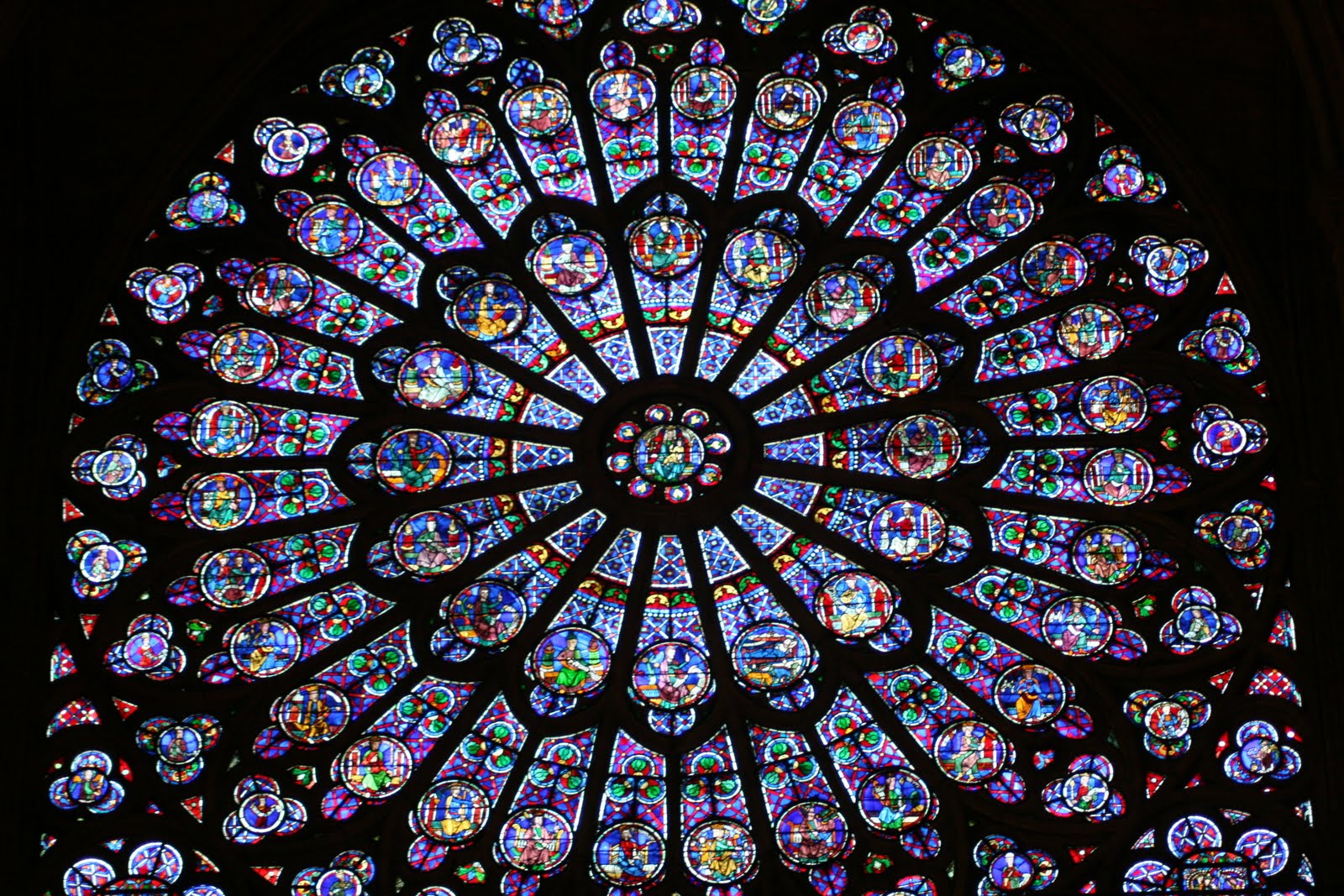
The Rose Window

Here's the thing with Sainte-Chappelle: it's unbelievable. As in, it nearly defies belief. The facts about this church fall into the "truth is way stranger than fiction" category.


The Holy Family going to Nazareth

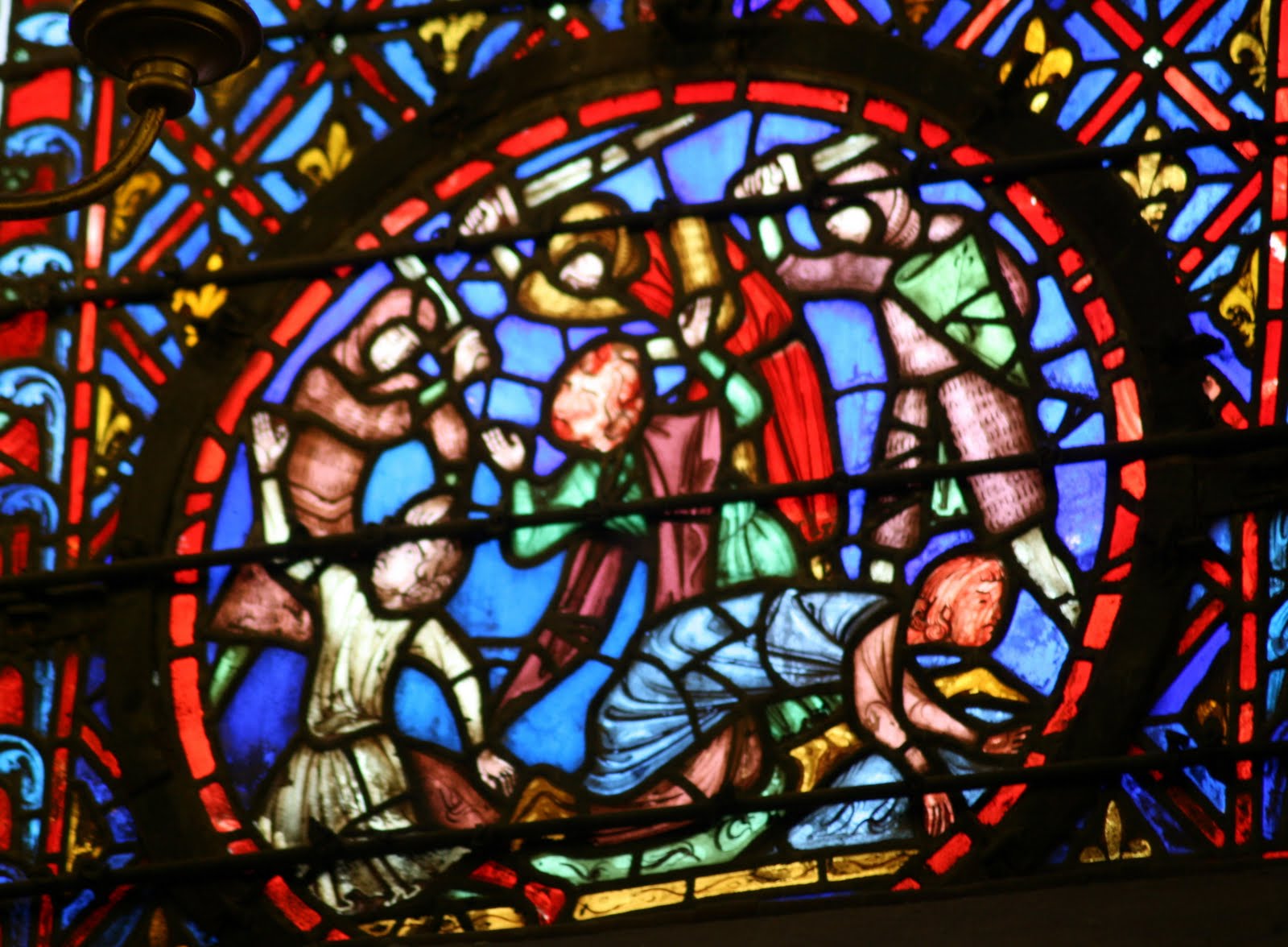
It's not that large. It really is 'just' a stone chapel (compared to, say, the Cathedral across the Île) though a very royal one, and an architectural and artistic wonder. The sanctuary walls are completely covered with stained glass: panels telling virtually every story from the bible, and a few "Go France!" type messages tucked in along the way.

This is some of the best of this kind of glass in the world; it's under restoration (which takes a long time, as you can imagine) and it's kind of tough to shoot, so have mercy on your humble photographer.


Knights and Pilgrims, doing their thing

Remember how long it took them to build Notre Dame? Couple hundred years. Know how many years it took to build this place? Fewer than 10. Thousands of panels of stained glass and all, and before the dawn of the 14th Century.


Priests and Sages discussing the design of the Girl Scout logo

The king in question was (Saint) Louis IX, who was one-of-a-kind: a peculiar mix of devout and suggestible. He loved the Church, loved the Pope, loved Jesus. LOVED them. Kind of went to crazytown in his enthusiasm, and spent vast fortunes on things like the "true" Crown of Thorns that Jesus wore at the Crucifixion, according to the account. Vast. Fortunes. Louis spent 135,000 livres (French currency of the era) in 1239 on that crown, convinced of its authenticity by Emporer Balwin II of Byzantium, who not coincidentally was also the guy who sold it to him. The king also bought a bunch of other relics, including a "Piece of the True Cross" (I know, I know) and over the next few years started construction on this church to house them all, dedicated to the glory of God, the Church, and France.


One of Herod's servants beheading John the Baptist, and wishing it was Louis IX

By the middle of 1248, the church was finished at a total cost of 40,000 livres. That's less than a third of the cost of the True Crown of Thorns to you and me, but still a princely sum. Well, kingly, in this case.
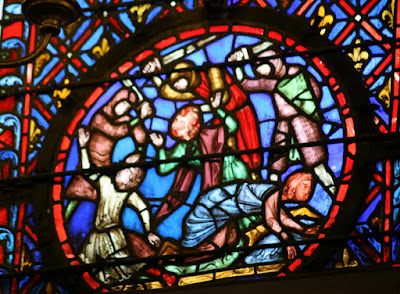

A bizarre initiation ritual for a Holy Roman Fraternity

All snarkiness aside, Sainte-Chappelle is a stunning place. And after all, Louis IX is far from the only head of state in history with a gullible streak. [I'll pause to let you reflect on that a moment...] And if you're going to misuse the public coffer, there are worse things you could do than build an incredibly gorgeous structure devoted to a supremely artistic account of religious texts and local history.

I'll leave you with a shot I took of the ceiling of the upper chapel. Placed the camera on the floor and set the remote timer so it could be perfectly still for a long exposure.


Wasn't counting on the surprise guest, but I'll call it a happy accident.

Thursday, October 21, 2010

Heaven is in the Details

Well, you knew this day was coming. This was a pretty churchy trip, and eventually we made it to the most famous Church of them all. (Well, other than that one in Rome.)


Notre Dame de Paris. Nearly 200 years in the making, many hundreds more as a gothic inspiration.


They say that heaven is in the details. Lately, I've taken that to mean that if you want to get to the crux of the thing, anything, look closer. See the big picture, sure, but keep looking until you see the things that go into it.


I would say that that approach works particularly well at a place like this cathedral. It has survived the Hugenots, the Revolution(s), Napoleon, the Commune, the Nazis and, well, just hundreds and hundreds of years. And it is Massive.


And awe-inspiring.


And ornate.


And see, just in these few images so far - the details start to emerge and tell a story that has more impact than what happens if you just go and get overwhelmed by this Big Huge Obligation of a Church. You notice the way the vast Rose window works from the outside, and you see the light pouring through it from the inside. You take in the Holy Mother ("Notre Dame" refers to her, after all) with her baby, flanked by angels in the front window. You might take a look at some of the other 36 (!) representations of her in and around the Cathedral. You look at the other figures sculpted into and onto the edifice.

And then you climb up to the top.

The way that happens is that you climb a bunch of stairs and then they make you wait in a holding area (which also serves as a gift shop, of course! They wouldn't want you to miss a chance to buy stuff.) until enough time has passed that some of the people already up there have gone back down, then you climb a whole BIG bunch of more stairs. We positioned ourselves so that we were at the front of the line when they opened up the door, so we wouldn't get caught behind any slowpokes, and Cory took the opportunity to charge up those steps. She seriously was on a mission. By the time we were about halfway up, it was she and I and one other guy who decided to keep up with us, and the rest of our group was way back behind.

And of course once we made it, Paris was there to greet us.


Sacre Coeur through the fog.


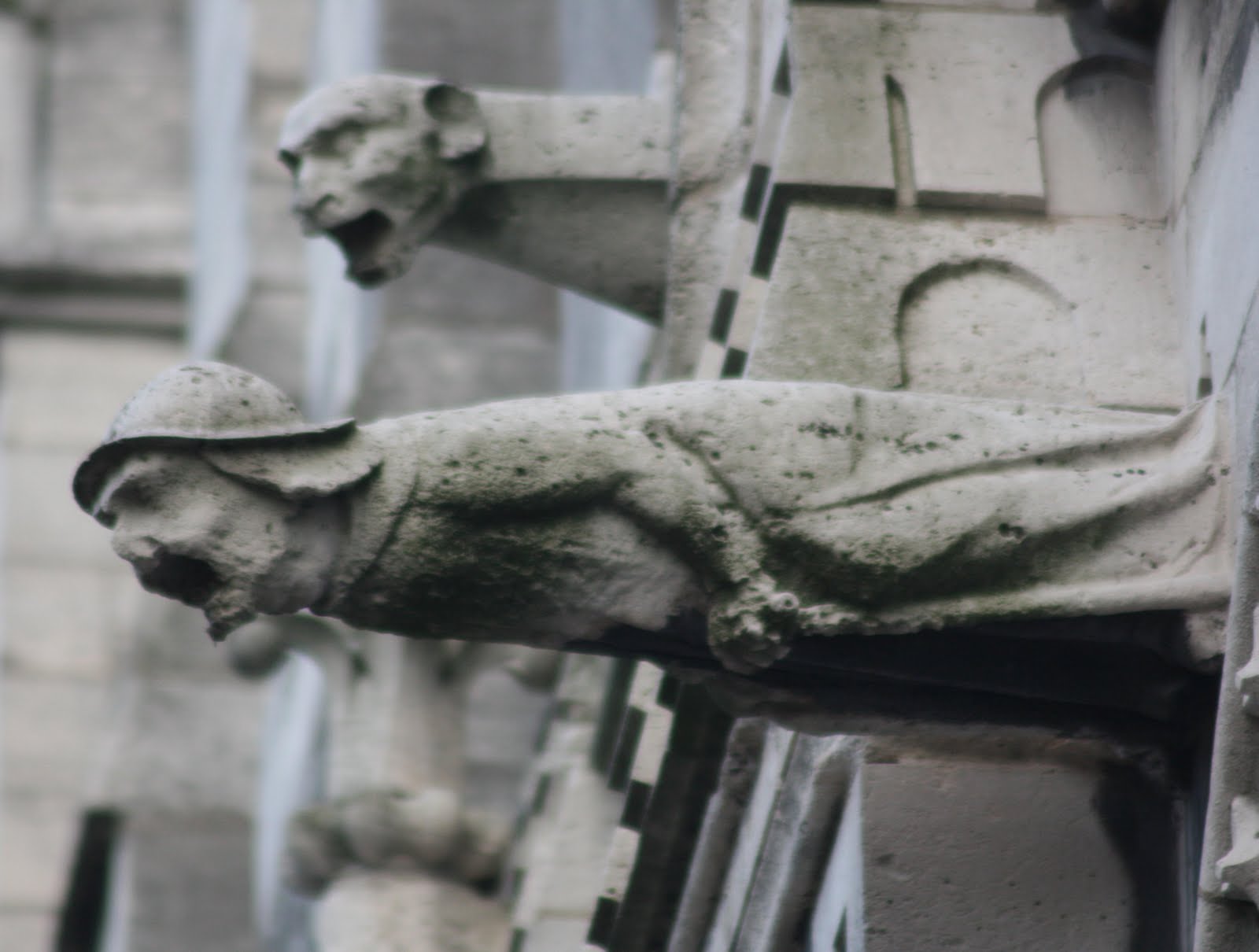
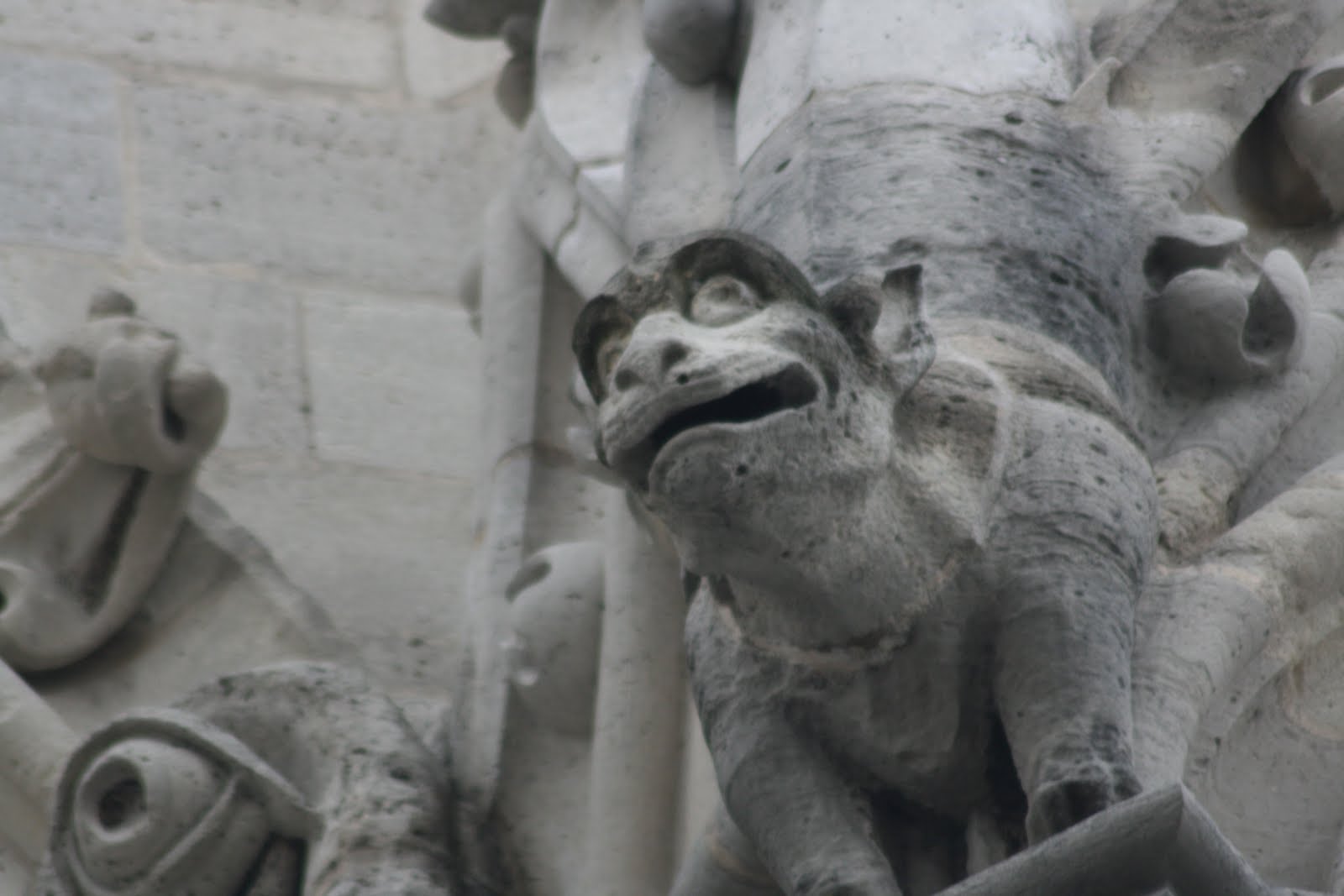
And the gargoyles were, if anything, even more amazing than I'd imagined.


Those of you who know your Gothic architecture (I, of course, am now an expert on Gothic architecture, having read at least two online articles and a few tourbook entries) realize that most of these guys are actually chimeras, rather than gargoyles (which are only properly so called when they function as water spouts) and that they were added as part of a 19th Century renovation.


What's incredible to me is how many individual treatments there are - each with its own character and, again, its depth of detail. This one may be the most famous, situated to greet you as you emerge from the stairs, and having been so often referenced in other art works. (Including, my nephew was quick to point out, The Simpsons.)


So many characters, each one unique. These are all full color photos, by the way (though that teaser from the earlier post was a B&W)


Now that you're fully involved in attending to details, you're surely wondering something along the lines of "Hey... wait a minute! If this was such a gray day, what's up with that blue sky and those cottony nuages in the establishing shot for this entry?"
Well, you caught me. We did stop by the Cathedral on two separate days. on Saturday, when it was bright and sunny, we took in the outside, and strolled through the sanctuary (that's also why the colors in the stained glass are so vibrant.) On the day we went to the top, Paris was muted by clouds.
Here are a few 'true gargoyles' from both days, with their functions as drain spouts still active.


One other thing before I go. Compare this last shot with the other two images of the most iconic chimera in this series (we'll call him "Moe") See how he changes depending on the light, on the juxtaposition with the other figures, or with the horizon and Sacre Coeur.


It's a pretty nifty world. Look closer.

Tuesday, October 19, 2010

Back to that Saturday in Paris

From the Opera House (remember the Opera House?) we made our way through the 1st Arrondisement (by way of the only disappointing meal we had the entire trip - I was so hungry and in need of caffeine by that point I allowed my judgment to slip and took Cory down with me. Sad. And we thought we were being so clever!) to feast on some art without a camera in tow.

L'Orangerie was the first stop. Stunning. Monet had a hand in the design and layout of the galleries of the upper level (where we concentrated our limited time there). An empty vestibule is situated there simply for the purpose of providing a moment of transition between the outside world and two very large oval rooms, each full of vast and justly iconic water lillies paintings. Monet's personal testament to peace, to the subtle and variable beauty of nature, to the silent center. It is a magnificent place, worthy of great respect, not to say reverence. You should go.

Walked through the Tuilleries to get to the grandest Musee of them all: the Louvre. Of course. We'd been there that first night - just walked through the corridor and heard a really good sax player and saw the pyramid and drank in the gorgeousness of the night. This was different. This was a full-on weekend day with buckets of tourists (including us) vying for a view. Now, the Louvre is too big to handle in a day. WAY too big. So we chose a few items of particular interest and saved the rest for another visit. Probably nothing you wouldn't also choose to see on your first visit: the Nike of Samothrace, the Venus de Milo, the Greek Friezes, the Mona Lisa.

SO - I will restrain myself to two things to say on the subject:

1) the Winged Victory/Nike is astounding. Truly awesome, in the sense of inspiring Awe. Powerful, amazing, alive. You can't get it from a picture. Trust me.

2) I may be the only person I know who was not disappointed by the Mona Lisa. This probably has to do with the fact that I've spent my whole life hearing people come back and talk about how small it is, and how disappointing it was, which led me to lower my expectations. Yes, the gallery was ridiculously crowded, and yes, it's behind this really think bulletproof glass and yes you have to stand several feet back. But even given all of that, I gotta say - this painting is kind of worth the hype. The photos do not do it justice, and neither do essays on sfumato. La Giaconda is quite the gal, and she's worth meeting in person.

But I will admit, I'd like to find a way to spend time with her away from the crowds...

Friday, October 15, 2010

Backtracking

Going back in time a bit...

After the Rodin Museum, we went to Musee d'Orsay, which was fantastic and incredible. Cory and I relied on some podcasts on this trip, and this was one of the places they came in handy. We didn't really have time to cover the whole place, so we let an online guide help us out. Some cheesy Rick Steves humor aside, it was useful to have some direction to streamline our visit, and the background information was rather good. Some of the info was outdated (floorplans/layouts evidently change with some frequency in Parisian museums) but that just gave us some small mysteries to solve. We communed with Degas and Renoir, Courbet and Cezanne, Daumier and Delacroix, Millet and Gaugin in this architectural wonder of a reclaimed railroad station. We got there too late in the day to get into what looked to be a pretty bitchin Van Gogh exhibition. But what the hell - you can't do everything.

Then we made our way to St. Chapelle where we were meeting friends for a piano concert. We had to wait on line outside for a bit longer than we'd thought, but that gave us the time to grab a quick cup of espresso from one of the friendly local establishments. (The Parisian's reputation for rudeness is not deserved, on the whole. Certainly no more so than in most of the places I've been.) St. Chapelle is gorgeous, with a fascinating history that I'll have more to say about later. Its beauty was very much muted by the evening darkness, but that helped to place a focus on the music. It was a concert of Chopin and Schumann solo piano works, in honor of this year being the 200th birthday for both composers. The pianist was Hugues Chabert, with whose work I must admit I was unfamiliar. It was a fine, intimate performance in a space that was sublime on a number of levels: accoustic, architectural. historical, aesthetic. And since I'm closer to worshipping music than any religious doctrine, let's go ahead and say it was a spiritual experience too.

As if that weren't enough, we then took a walk over to the Right Bank, where we sought a place to eat without the benefit of personal (or guidebook) recommendations, and settled on a no-frills but thoroughly delicious spot. I don't remember what Cory had*, but my duck confit was fab, and so was the Bordeaux that Johnathan picked out.

It was a pretty good day.


*Cory just reminded me that she had Quiche Lorraine. She enjoyed it. It felt very French.

Friday, October 08, 2010

Musee Rodin (or, Hell is in the Details)

After a most delectable lunch of galettes and cider with Christina and Johnathan at a creperie called Josselin, we went over to the Rodin museum to get our sculpture on.


The weather turned before long.


So we just took that opportunity to go to the indoor part of the museum (converted from the residence where Rodin lived for several years toward the end of his life).


For this next one, I pretended to be shooting a sculpture but got a nice shot of Cory peeking around it


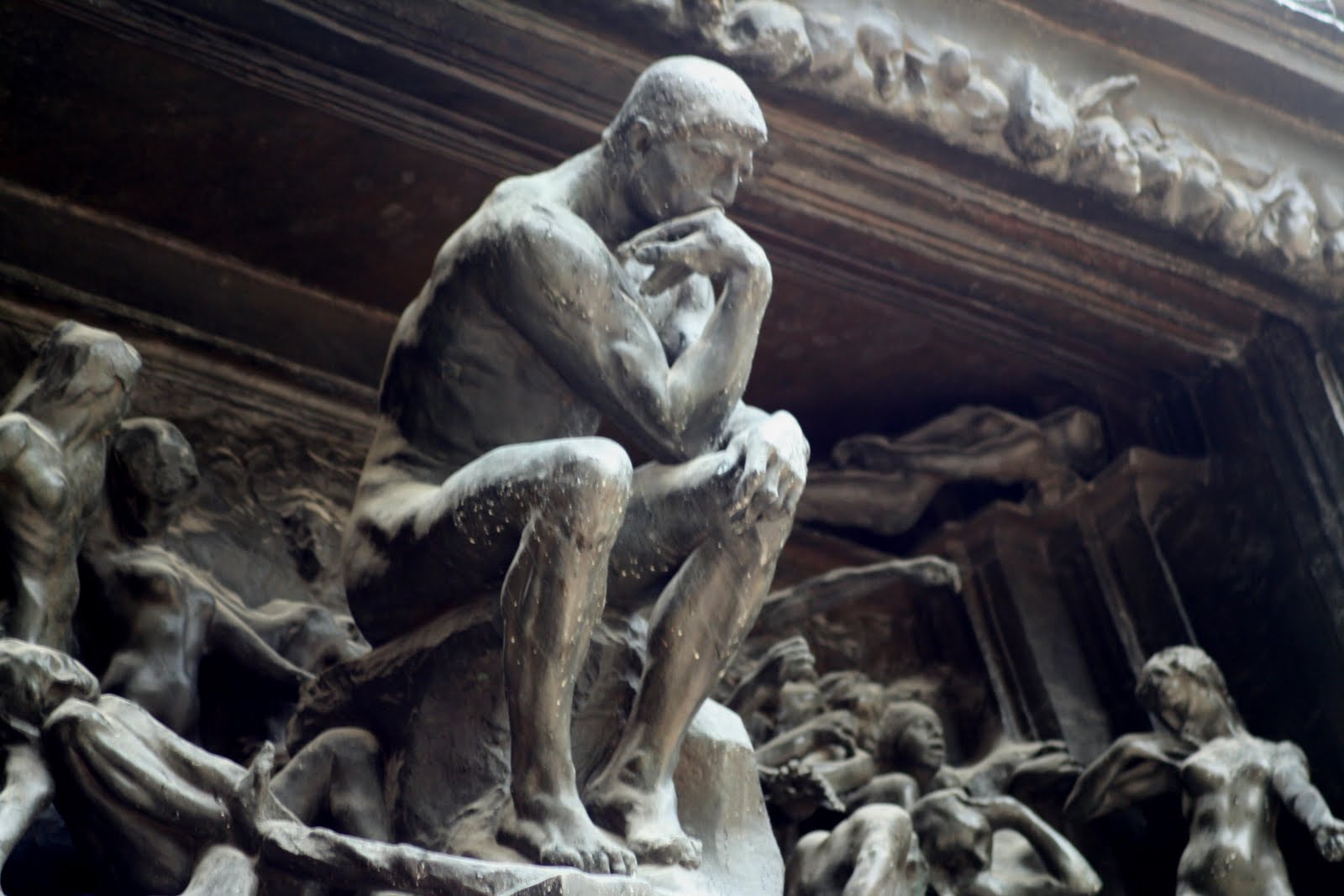
It was a fantastic museum, of course. I wasn't too shutter-happy inside, but when we went back outside, I got drawn into the Gates of Hell pretty deep.


Like Milton and Marlow, Bosch and Goethe and (especially) Dante, Rodin had a special fascination with the infernal, and and it was the subject of some of his best work.


I'm the first to admit that it can damage the experience (and be just plain annoying) to spend one's travels totally focused on taking photographs or shooting video. But by the same token, if you maintain a balance, the camera can help you pay attention to visual elements in a number of ways. I spent a lot of time on this trip engaging with details in some fairly grand works of art and architecture.


You can see the raindrops on the bronze in some of these - it rained pretty hard while we were inside, and it sprinkled on and off when we went back out too.

Rodin worked directly from Dante's Inferno to make this masterpiece, and he incorporated elements of some of his other major sculptures.


It was a pretty wonderful museum experience. This was mid-afternoon on our second day there.

I'll leave you for now with a reminder that the Eiffel Tower should never be interpreted to have any phallic significance whatsoever.